How to Write Perfect AI Photo Editing Prompts Using ChatGPT 2026
Artificial intelligence has completely changed the way we create and edit photos. Today, you don’t need to be a professional designer or photographer to create stunning images. With ChatGPT and AI image generators, you can generate cinematic portraits, realistic photos, anime artwork, product images, and social media graphics in just a few minutes.
However, the quality of your AI-generated image depends on one important thing: your prompt. A detailed and well-written prompt tells the AI exactly what you want. The better your prompt, the better your final image.
In this article, you’ll learn how to write perfect AI photo editing prompts using ChatGPT, even if you’re a complete beginner.
What Is an AI Photo Editing Prompt?
An AI photo editing prompt is a written description that tells an AI model how to create or edit an image.
Instead of manually editing a photo, you describe the image in words.
For example:
Basic Prompt
A boy standing on a road.
Better Prompt
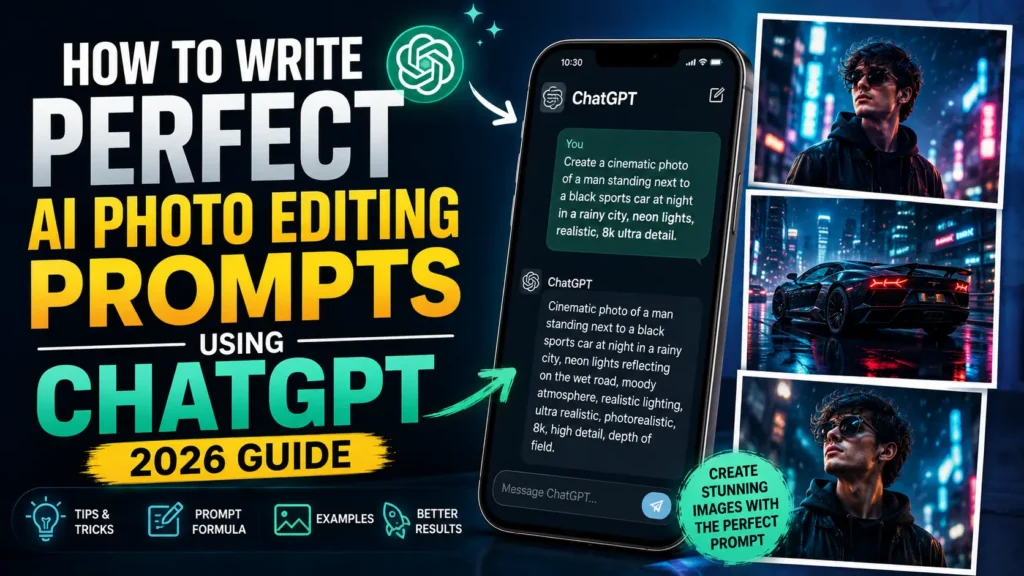
A young man wearing a black leather jacket, standing on a rainy street at night with neon lights reflecting on the road, cinematic lighting, ultra-realistic, DSLR photography, 85mm lens, shallow depth of field, 8K HDR quality.
The second prompt gives the AI much more information, resulting in a higher-quality image.
Why Use ChatGPT for AI Photo Editing Prompts?
ChatGPT makes prompt writing easier by helping you:
Instead of thinking about every detail yourself, ChatGPT can organise your ideas into a clear and effective prompt. Also read Free Prompt-Seen AI Photo Editing Prompts 2026
The Perfect AI Prompt Formula
A great prompt usually includes these elements:
Subject
Describe the main person, object, or scene.
Examples:
Appearance
Describe clothing, hairstyle, facial expression, age, or accessories.
Example:
Wearing a white hoodie and black sunglasses, smiling naturally, with short curly hair.
Background
Tell the AI where the subject is.
Examples:
Lighting
Lighting makes a huge difference.
Popular styles include:
Camera Details
Professional photography terms improve realism.
Examples:
Image Quality
Always mention the quality you want.
Examples:
Art Style (Optional)
If you don’t want a realistic image, specify a style.
Examples:
Complete AI Prompt Example
Here is a strong prompt you can use as inspiration:
Create an ultra-realistic portrait of a young man wearing a black hoodie and sunglasses, standing on a rainy street with colorful neon lights, cinematic lighting, DSLR photography, Canon EOS R5, 85mm lens, shallow depth of field, realistic skin texture, dramatic shadows, vibrant colors, 8K HDR quality.
This prompt is clear, detailed, and likely to produce a polished result.
Use ChatGPT to Improve Your Prompts
You don’t need to write everything yourself.
You can ask ChatGPT questions like:
ChatGPT can quickly refine a simple idea into a professional prompt.
Best Prompt Styles
Common Prompt Keywords
Adding descriptive keywords often improves results:
Use only the keywords that match the image you want.
Mistakes to Avoid
Many beginners make these mistakes:
Using Very Short Prompts
Too little detail can lead to generic images.
Mixing Too Many Styles
Combining unrelated styles may confuse the AI.
Forgetting Lighting
Lighting has a major impact on the final image.
Ignoring Background Details
A well-described background makes the scene more believable.
Not Mentioning Image Quality
Including quality terms often leads to sharper, more detailed images.
Tips for Better Results
Prompt writing is often an iterative process, and small changes can noticeably improve the outcome.
Final Thoughts
Writing perfect AI photo editing prompts is a skill that improves with practice. ChatGPT makes the process easier by helping you organize ideas, add meaningful details, and refine your descriptions into clear, effective prompts.
Whether you’re creating realistic portraits, cinematic scenes, anime artwork, or social media content, focus on describing the subject, setting, lighting, camera style, and overall mood. As you experiment and refine your prompts, you’ll learn which combinations produce the results you like best and create more impressive AI-generated images over time.