
EPS Pension Increase from ₹1,000 to ₹7,500? Check Now
Many people are seeing claims on social media that the EPS pension will increase from ₹1,000 to ₹7,500 in 2026. These messages are spreading confusion between pensioners and employees. Some posts on WhatsApp, Facebook, and websites claim that the EPS-95 pension has already been increased and is effective until January 2026; however, this information has not been confirmed.
In this article, we will explain the real situation in simple terms, so you can clearly understand what is true and what is not.
What is EPS Pension?
This Employees’ Pension Scheme 1995 (EPS-95) is a social security program launched in November 1995 under the Employees’ Provident Fund Organisation (EPFO). It is managed by the Ministry of Labour and Employment, Government of India. This scheme gives a monthly pension to employees after retirement. It also supports family members in case of the employee’s death.
Under EPS-95, private sector employees are eligible to receive a monthly pension after retirement, provided they have completed at least 10 years of eligible service. The scheme also provides:
Currently, around 78 lakh to 81 lakh pensioners across India receive pension under this scheme every month.
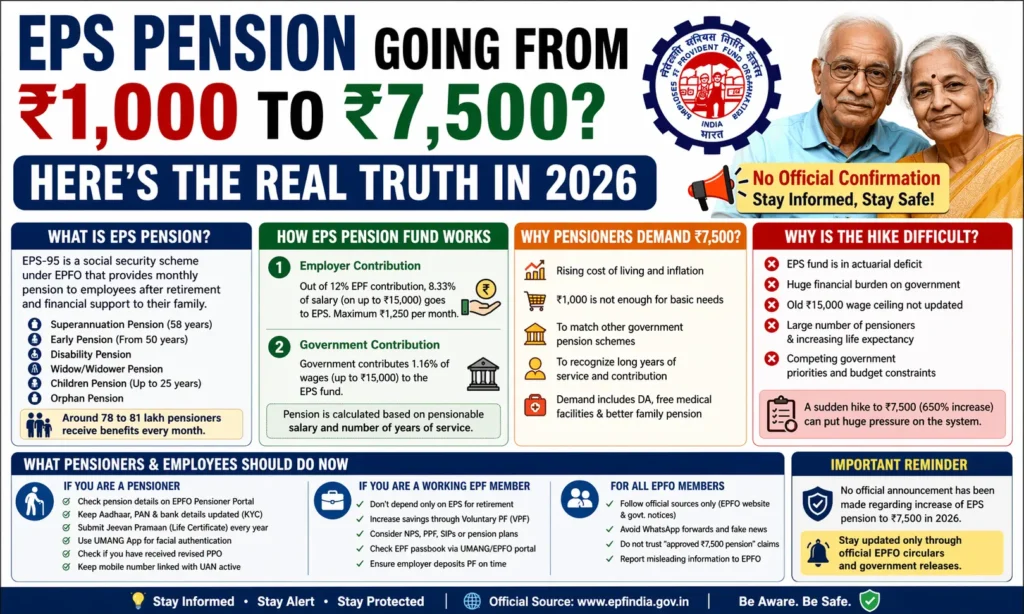
How Does the EPS Pension Fund Work
To better understand the ₹7,500 pension discussion, you first need to know how the EPS pension system works. The pension system under the Employees’ Provident Fund Organisation is mainly funded through two sources:
1. Employer Contribution:
When your employer deducts 12% of your basic salary as EPF contribution, the entire 12% does not go into your PF account. Out of the employer’s 12%, a portion of 8.33% of salary (capped at ₹15,000) goes into the EPS fund. This means the maximum employer contribution to EPS is ₹1,250 per month (8.33% of ₹15,000).
2. Central Government Contribution:
The Government of India contributes 1.16% of wages (up to the ₹15,000 limit) to the EPS fund, which represents its share of the pension liability.
Your pension is calculated based on your pensionable salary and the total number of years you have worked. The Employees’ Provident Fund Organisation uses a fixed formula that combines these two factors to decide your final monthly pension after retirement.
Why the ₹1,000 Pension Is Not Enough Today
The minimum pension of ₹1,000 was set in 2014 to provide basic financial support to retired workers. At that time, it was considered a small but helpful amount for low-income pensioners.
However, in today’s situation (2026), this amount is very insufficient due to rising living costs. Daily essentials such as groceries, medicines, doctor visits, and utility bills often cost much more than the monthly pension itself.
For example:
Because of this, ₹1,000 per month is not enough to cover even a few days of basic expenses. Many pensioners receive only a slightly higher average amount, which remains very low compared to their long years of service under the Employees’ Provident Fund Organisation.
This gap between income and expenses is why pensioners are demanding a higher pension amount, like ₹7,500. This issue is not just financial; it directly affects the quality of life, health, and dignity of retired employees who depend fully on this pension for survival.
History of the ₹7,500 Pension Demand
The demand to increase the minimum EPS pension to ₹7,500 per month, along with Dearness Allowance (DA), has been raised by pensioner groups and workers’ associations for many years. One of the main organizations leading this movement is the EPS-95 National Agitation Committee, which represents around 81 lakh pensioners from different sectors, including government, private companies, and media organizations.
These groups have been continuously requesting better pension benefits because the current amount is not enough to cover basic living expenses.
Key demands of Higher Pension:
Why Pensioners Demand ₹7,500:
Why the Pension Increase Is Still Not Approved
This is the most important point, and the answer is mainly linked to the financial structure and sustainability of the pension system under the Employees’ Provident Fund Organisation.
- EPS Fund Is in Actuarial Deficit
2. Huge Increase in Financial Burden
3. Old Wage Ceiling System
4. Large Number of Pensioners
5. Competing Government Priorities
Now What Pensioners and Employees Should Do
Whether the ₹7,500 pension increase happens or not, every EPS member and pensioner should take a few important steps today to stay safe and prepared under the Employees’ Provident Fund Organisation system.
If You Are a Pensioner:
If You Are a Working EPF Member:
For All EPFO Members:
Benefits of EPS Pension
EPS (Employees’ Pension Scheme), managed by the Employees’ Provident Fund Organisation, provides financial support to employees after retirement. Here are its key benefits in simple words:
Conclusion
The EPS pension system managed by the Employees’ Provident Fund Organisation plays a very crucial role in the lives of millions of retired employees in India. Many EPS-95 pensioners are unhappy with their low pension after years of service, and this issue has been raised by committees and discussed in Parliament.
For many people, this pension is their primary source of monthly income after retirement, so even small changes make a bigger difference. Now, there are many discussions and hopes about increasing the minimum pension.
However, many social media posts and messages spread incomplete or misleading information. At this stage, it is important to stay up-to-date only through official sources, keep your EPFO records correct, and avoid relying on unverified news. Any real update will always be announced through official EPFO circulars or government press releases.